Also a report on a seriously-posh wedding and having famous people in my office. The paragraphs in italics are all extracts from reports and family letters from 1993.
Thanks for reading From the Bush to Bush House and Beyond! Subscribe for free to receive new posts and support my work.
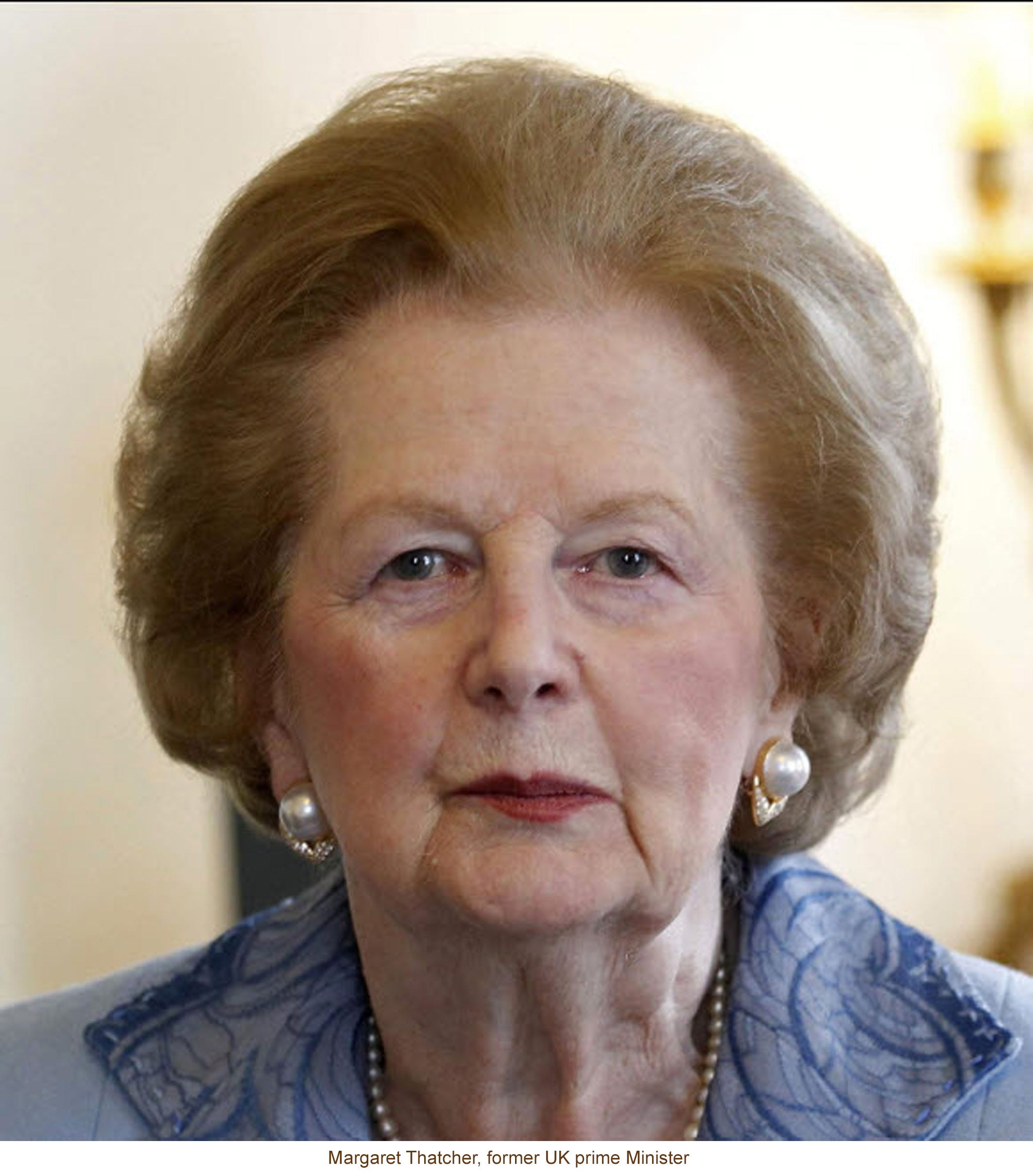
Lady Thatcher -- always referred to by one British newspaper columnist by the wonderful name, Mrs Hacksaw -- has been back in the news with her attacks on her successor, John Major, and others for failing to nuke the Serbs. She was interviewed on World Service Television and it was my task to be her official “greeter” and host. It was like meeting a ghost. She had very white make-up and rather watery eyes. Sadly, no photographs were taken of her at this visit to Television Centre. The best I can do is post this photo taken at about the same time, but without the white make-up:
It was fascinating to watch her “switch on” the moment the interviews began. It was a typically aggressive Thatcher performance: no holds barred and always attempting to make it appear that legitimate journalistic questioning was quite simply an outrageous attack on her public spirited nature. Frankly, the old witch is barking mad; even madder than when she was in her final years of power. It was hard to believe that it wasn’t so long ago that she held this country in an iron grip.
As I escorted her from Television Centre and back to her security officers, she asked what I thought of her interviews. “Oh they were fine with some powerful points,” I lied because I wanted to keep my job. But I really wanted to say “Don’t ask me for my opinion, you nasty old bat,” but didn’t, of course.
It was my third meeting with Mrs Hacksaw. The first was when she was opposition leader and wanted to meet any journalists working for media outlets in New Zealand. The declared reason was to get some flattering articles filed to NZ in advance of her visit to that country. She failed because she just couldn’t resist being rude to the journalists. The second time was when she was Prime Minister and Rosemary and I went to a reception at 10 Downing Street for the Foreign Press Association. As she circulated among the journalists, she came to Rosemary and I and a married couple from the NZ Herald. As we chatted politely, Thatcher was told by the Kiwi woman that as a teacher she was finding it difficult convincing her pupils that they would all get jobs when they left school. Thatcher responded by telling the woman “All I can say to you is that you must be a terrible teacher”. At that she abruptly turned away to talk to someone she considered held more positive views.
As the evening progressed, we were approached by a woman who identified herself as the wife of the Cabinet Secretary for Wales, Nicholas Edwards, Baron Crickhowell. Rosemary told her that her husband’s brother, David, was our immediate neighbour. Her face lit up. “Oh really,” she said, “I must get Nicholas.” She walked off and returned a short time later with Baron Crickhowell. “These people are David’s neighbours,” she told him. “How interesting,” he said and asked “have you met his girlfriend?” They seemed very surprised to learn of David having a relationship. We admitted that we weren’t aware that the reclusive widower had a girlfriend. I don’t think we did meet Faye until after she and David married. We later learned they had met through a dating website or somesuch. They had both since died and there are new occupants in the property.
From a letter dated May 25 1993:
UPS AND DOWNS OF WSTVN
Life with World Service Television News continues to be pretty hectic and unpredictable -- and often exhausting. The trouble is that we are expanding at a rate way beyond the wildest expectations. Our newsroom is about to go through its second rebuild in just under six months, doubling its size. We are now broadcasting to the whole of Africa, as well as Europe, most of Asia and the Persian/Arabian Gulf. It will take a while for the Africa audience to build up, I suspect, because there we are mostly available only to cable subscribers. But our audiences in Asia are already staggeringly large. In India alone, the audience is already said to be in excess of 20 million. All the indications are that where we are in direct with America’s Cable Network News (CNN), we are beating the pants off them. One Indian survey showed 80% were watching us and just 11% watching CNN.
We are told that WSTV will be available in Australia fairly soon, but the details have yet to be finalised. Canada is also high on the expansion list.
Some of the news presenters are still as difficult as ever. A substantial part of my job is what is only half-jokingly referred to as Head of Egos. Sometimes the presenters drive me nuts with their self-centred and relentless complaining.
My worst Head Case Ego recently got a great deal of publicity in the tabloid press when she effed and blinded her way through a speech during a Cambridge University Union debate. She seemed to think it was amusing, but I thought it was just further evidence of her serious immaturity. Just as well the public doesn’t realise how incredibly childish television “stars” often are. I suppose the problem is that most news presenters and other “stars” are fairly inadequate personalities. After all, what normal person would want to be recognised and fawned over every time he or she stepped outside the front door? There would be no private life or sense of perspective.
Sadly, I have lost my best and most grown-up presenter, Ian Smith. Nearly three months ago he fell 100 metres down a glacier on a skiing holiday in France and suffered such severe brain damage that it is extremely unlikely he will ever work again. It is tragic to see him reduced to little more than a vegetable.
From a letter dated July 4 1993:
WONDERFUL WEDDING
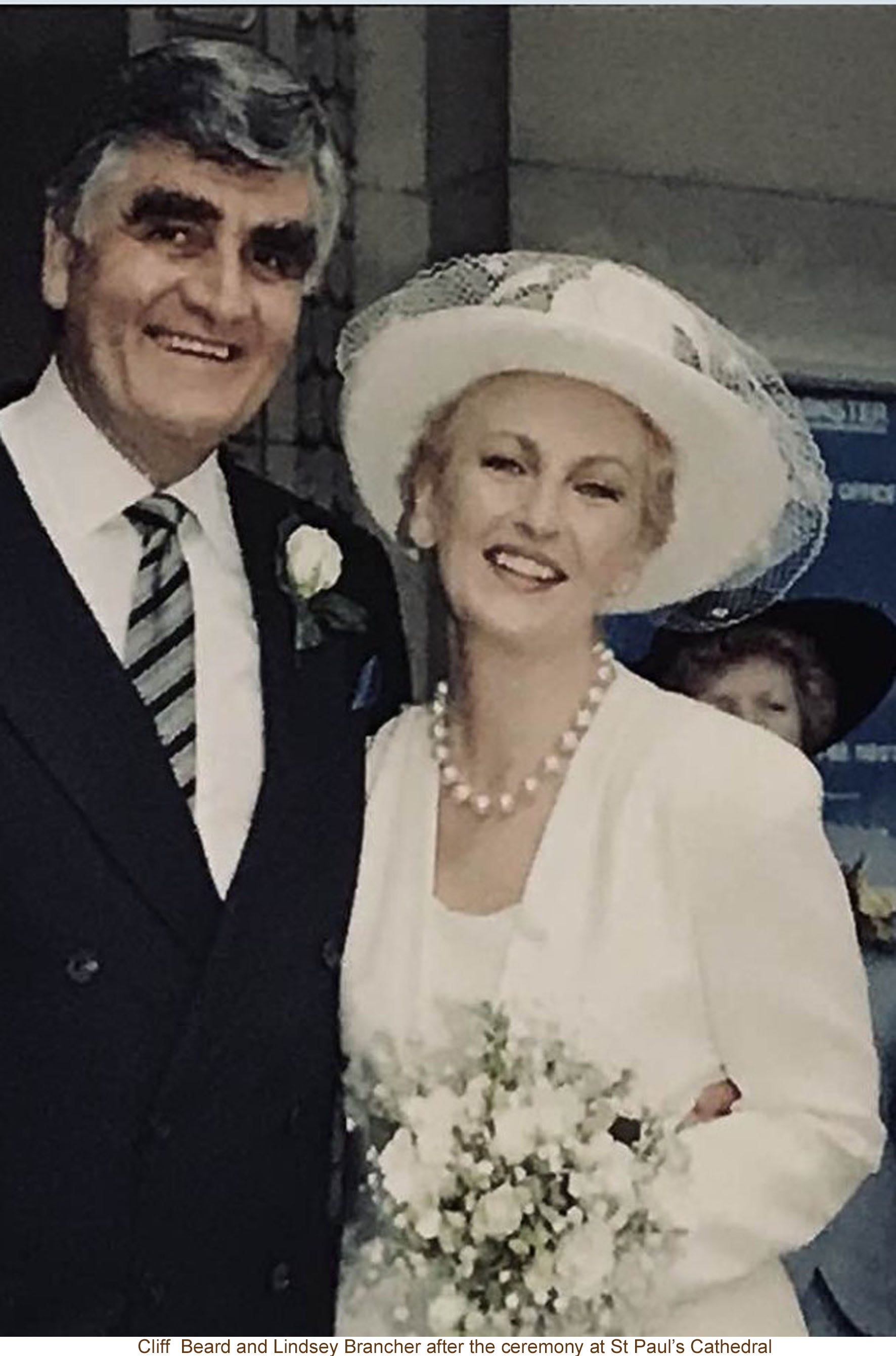
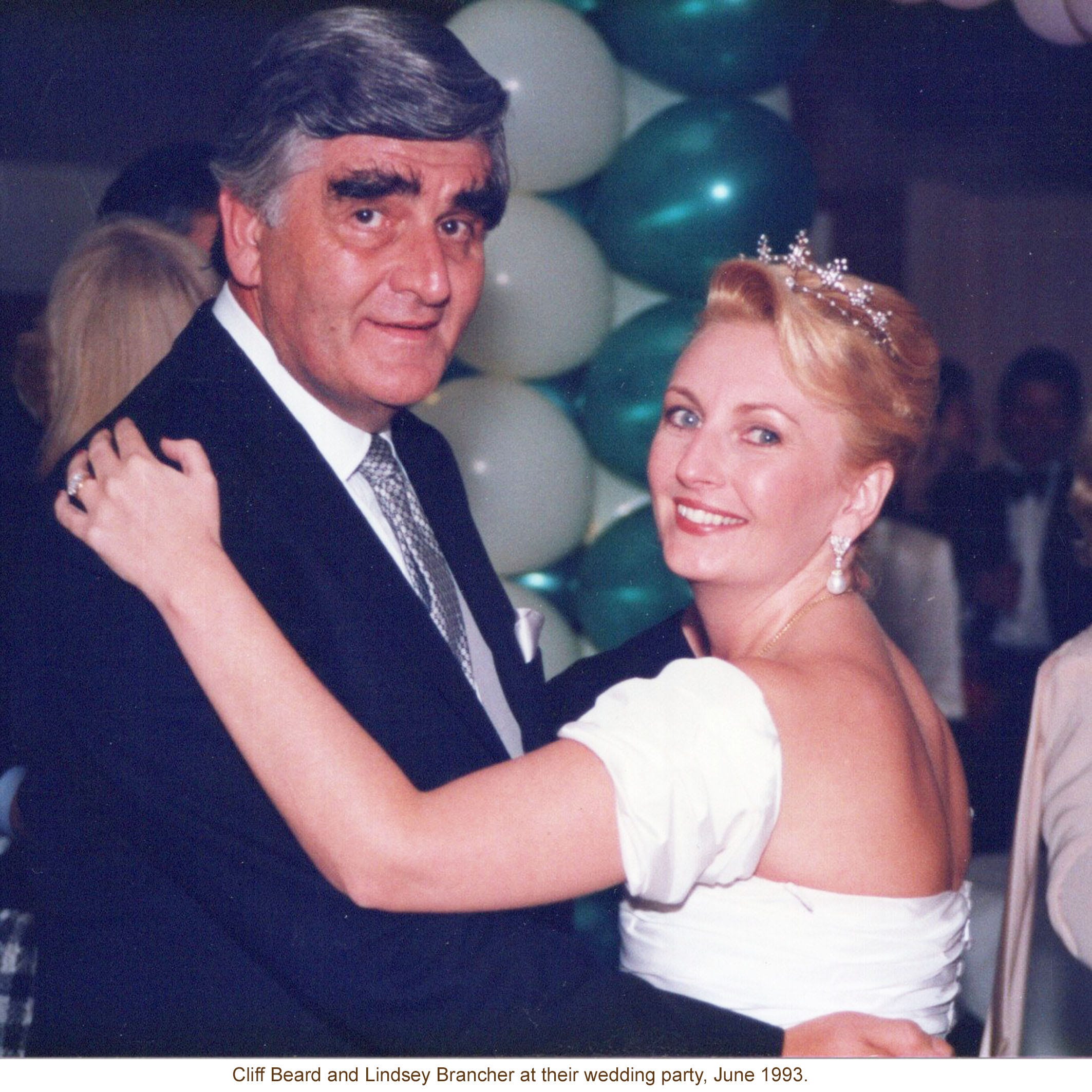
Rosemary and I recently went to an amazing wedding. One of World Service Television’s lovely woman presenters, Lindsey Brancher, married Cliff Beard, a very rich businessman (at least he was before the wedding!) and it was an all-stops-out affair. The wedding itself was a civil ceremony because both were divorced, but the blessing was in the crypt of St Paul’s Cathedral before 230 guests. It was a lovely ceremony.
This was followed by a wedding lunch for the immediate friends and members of the families, and in the evening a party for the rest of us. Monkey Island, an island on the Thames at Bray, west of London, was taken over for the event. It isn’t any ordinary island. On it are an hotel and a restaurant in their own lovely grounds inhabited by tame peacocks. Lunch took place in the presence of, among other things, a string quartet.
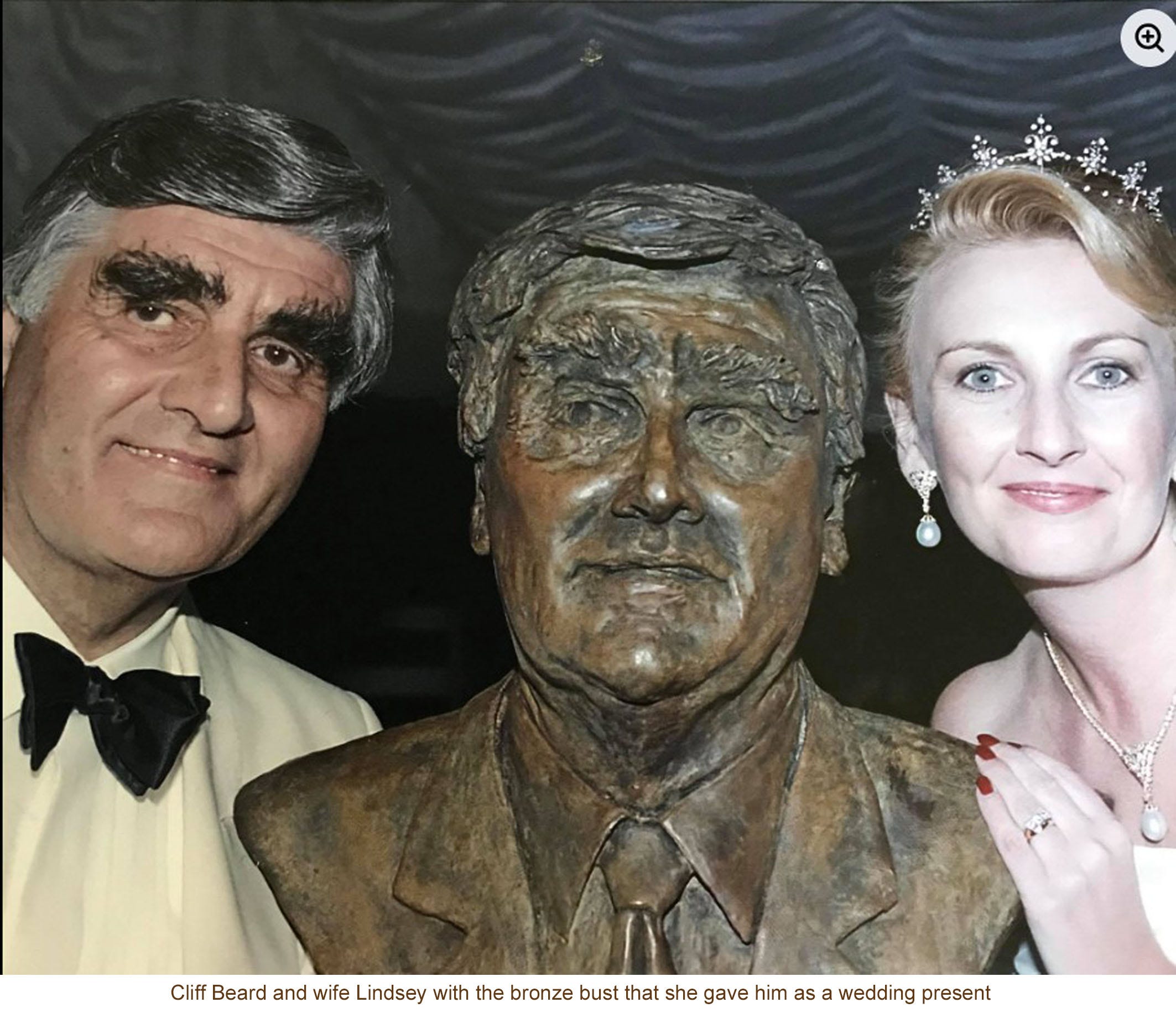
The evening party was a knockout. There were unlimited drinks, including champagne, and a terrific dance band that could play everything from the traditional ballroom numbers to a very creditable Rolling Stones medley. We were also entertained with croquet and clay pigeon shooting. At 10.30pm, as darkness fell, there was a Mother Of All Fireworks Displays. It went on for 30 minutes and exceeded anything any of us had ever seen. After that, there was the cake-cutting ceremony, during which the bride unveiled her present to her new husband: a bronze bust of him! He, in turn, gave her a watercolour painting and a large hand-engraved glass bowl.
At midnight, the wedding breakfast was served. Then just before 1am, the couple went to the very classy Cliveden Hotel to spent their first night as a married couple. Then they were off on their honeymoon in Venice. The whole day was recorded by two professional television cameramen, a professional wedding photographer, and a professional artist. It was all gloriously over the top. But if it had been done by anyone else, it would have been hard to take. In fact, everyone agreed that it was a wonderfully happy event. The only question still being asked is: “How much did it cost?” We don’t know, but it was lots and lots. And that wouldn’t include the day trip to the pyramids on Concorde, during which Cliff made his proposal of marriage!
Extracts from a family letter dated November 3 1993:
ARABIC NEWS PROJECT
My work with the Beeb remains busy and interesting. We have just completed a re-design of our News and Information Channel. This included a new studio and set, several more hours of news each day, and an entirely new image. It seems to have gone down very well.
In another development, I am soon to move to another job for about six months. I will retain my News Development Editor title but will become a full-time member of a small project team responsible for setting up an Arab-language satellite television service. Although negotiations are still going on and final contracts have yet to be signed, the new service is likely to be at least as big as our English-language satellite service. The satellite footprint will cover all the Middle East and North Africa. It is going to be an extremely challenging, if not hair-raising, project. For a start, we have to recruit something like 250 Arab journalists, translators and broadcasters, all of whom will have to be fluent in English as well as Arabic. That alone will be one hell of a job. It also means finding and designing a new studio and another newsroom.
The Arab project has brought to a head the tensions between BBC World Service Television and Rupert Murdoch, who recently gained control of Star Television, the pan-Asian satellite service that carries our channel and which currently attracts an Asian audience of around 60-million. Murdoch is thought to have plans to give World Service the elbow and replace us with his own British-based Sky-TV news channel, which he hopes to turn into an international service. The trouble is he can’t afford to get rid of us yet because we are Star TV’s biggest revenue earner. So, it looks as though he is stuck with us for a while, and in the meantime, we are looking at the options open to us on other Asian satellites. The cause of particular grief with Murdoch is the fact that the Star TV signal substantially overlaps that of the projected BBC Arabic channel. This wouldn’t matter if it weren’t for Murdoch’s plan to set up his own Arabic TV channel. At one stage, he was threatening to close down the BBC channel on Star if we didn’t scrap the Arab project, but the BBC took him to the High Court in London and forced him to withdraw the threat. Round One to us, but we are sure that the war is just beginning. [Murdoch did later switch off the BBC, but that was for a different reason I have yet to explain.]
HOSTING THE FAMOUS
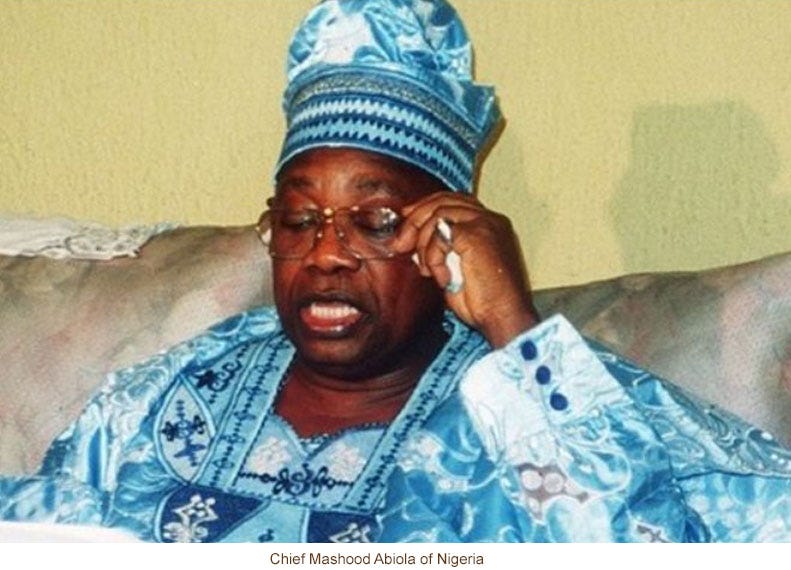
One of the attractions of my job is the number of internationally-famous people who agree to come Television Centre to appear on the World Service channel. Hardly a day goes by without a government minister or president turning up to appear on our programmes. They would often be seated with me in my office while waiting to be taken to the studio. One of our most colourful guests has been Chief Mashood Abiola, the man who won the Nigerian Presidential Elections a few months back, but who was stopped from taking power by the military. He is a man of considerable stature and wears spectacular tribal outfits.
One of our more fashion-conscious women producers says she could hardly restrain herself from asking him who designed his “frocks”. I dropped a diplomatic clanger when I asked if I could take a photo of the chief for the BBC. He happily agreed until I suggested he should remove his hat. “No,” I was firmly told, “that’s part of my outfit!”
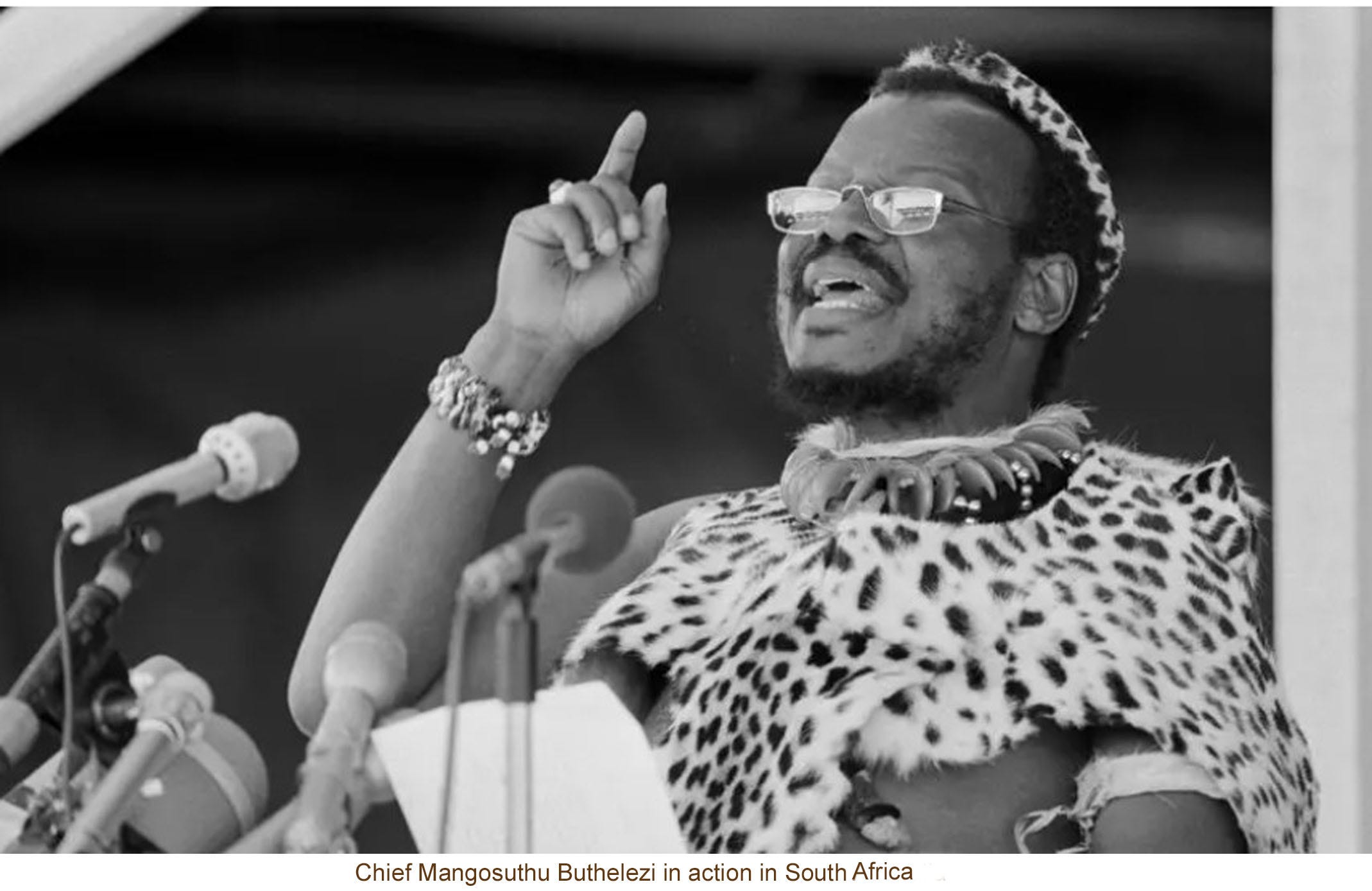
I recently played host to a rather slight, apparently-shy African gentleman. He was Chief Buthelezi, head of South Africa’s Inkatha Movement. It was hard to believe that this inoffensive-looking chap indulging in small talk with me in my office was in reality someone who was indirectly (and perhaps directly) responsible for hundreds of killings in the increasingly-vicious anti-Apartheid power struggle now going on in South Africa.
I recently also had to play host to ex-King Constantine of Greece who was invited to participate in a BBC World Service Television programme. He was anxious that the presenters pronounced his name correctly: (ConstanTEEN, not ConstanTYN). This reminded me of a story our deputy editor told me of the time when Constantine was still king and she was producing a programme that had him as guest. It was arranged that he be brought to the studio in a BBC car. Harry, one of the seen-them-all BBC staff chauffeurs, was assigned to the task. As Harry showed Constantine into the hospitality room, he introduced the production staff, then turned to him and asked: “And where did you say you were king of?”.
From a letter dated December 11 1993:
JOBS FOR THE BOYS
I have just been talking to Niall. He and his flat mates now have a phone. It is for incoming calls only, so that they don’t run up big bills making calls. But it suits us because it allows us to contact him with ease. He has been doing a lot of useful work around our house and doing odd jobs for other people. It helps keep him afloat financially and allow him the occasional luxury. This afternoon he and his mates all chipped in to hire a recording studio for a couple of hours for a musical jam.
Harley will be back next weekend from university for his month-long Christmas break. He plans to take some casual typing jobs for a couple of weeks to earn some money, then to take the other two weeks off. He is in good spirits. He is earning a bit of extra money here and there by designing and typing essays for fellow students at Nottingham University. He charges a pound a page. He does the typing on his Apple Macintosh Computer which has a simple desk-top publishing programme.
ARABIC TV NEWS DELAY
The signing of the contract to set up a BBC Arabic Television Service is still being delayed by the lawyers from both sides going through every page word-by-word and line-by-line. It is driving us nuts, but the High Ups seem confident that the contract will eventually be signed. I have handed over about half of my World Service TV News responsibilities to another chap, so that I can concentrate on the Arab Project. We do our first programme pilot tomorrow to try to establish how many translators will be required. I expect to be doing a lot of travelling over the next few months: to Rome, the home of the headquarters of the Arab satellite company, and to such places as Cairo and Amman to set up a network of Arab correspondents.



Well, Helen, Thatcher's hair was always tidy, but I didn't think that made her a very nice person!
All the best to a wonderful Aussie friend and follower.
Very interesting..
I always liked and admired Maggie Thatcher's strength
Always immaculately presented..
Cheers to you & Rosemary xx
Helen ...Australia