

Chapter 76: Another BBC adventure
My report on a working trip to Bucharest and Belgrade in May 1990.

This trip was the third and final part of my survey of the BBC’s Central Europe patch.
The only flight available from London to Bucharest was on Tarom, the Romanian national airline. I was assured that Tarom planes usually made it to their destination – a naturally comforting thought – but was warned that I should not expect first class service.
My first discovery at Heathrow was that there was no seat allocation. It is, I was told, “free seating”, which meant that the first on board got the best seats -- just like on a bus, I guess. I made sure I placed myself close to the terminal exit leading to the plane. I was consequently able to get a good aisle seat up the front of the British-built BAC 1-11 aircraft. The interior of the plane was pretty worn, but was clean, except for the dreadful toilets. There was a very strong smell in the plane, rather like mouldy socks, but it either went, or I got used to it, once the plane rose into the air.
The cabin crew consisted of just three people for the entire plane which, on this flight, was almost full. The hostesses had the cheerful demeanour and appearance of barmaids left over from the early l960s, bleached hair and a couple of good dollops of rouge. The meal we were given must qualify as the worst I have ever seen on a plane. It was an extremely unattractive assortment of stale bread rolls, cheese and cold meat. The drinks on offer were lukewarm Pepsi-Cola or mineral water, or black tea or coffee (“Sorry, we have no milk.”). Fortunately, I’d had a snack at the airport, so was able to put most of the meal aside without being overcome by hunger. Just as well, too, as the flight lasted nearly three hours.
Bucharest International Airport was quite dreadful. It was a dreary concrete building, with a dirty, gloomy and noisy interior. I went through immigration and customs without difficulty, but it took an hour for my luggage to turn up on the terminal’s sole carousel. The carousel sounded as though it had never seen a drop of oil since being installed and screeched and clanked away, drowning all but shouted conversation.
The trip into town was interesting, if only because the taxi nearly sent a drunk on to another world. He braked to avoid three drunks crossing the highway, when suddenly one of them decided to play “chicken”, hurling himself in front of us – and came within inches of being not just drunk, but dead, or at least severely injured.
My hotel, part of the Inter-Continental, is said to be the best in town, which doesn’t say a great deal. It was okay, but like all hotels in what used to be the Communist bloc, it just didn’t make it as a class hostelry. Certainly, it wasn’t worth $US125 a night. Still, why am I complaining? It’s a considerable improvement on anything to be found in Moscow. Interestingly, all the prices in the hotel are quoted in American dollars and the first language used is always English.
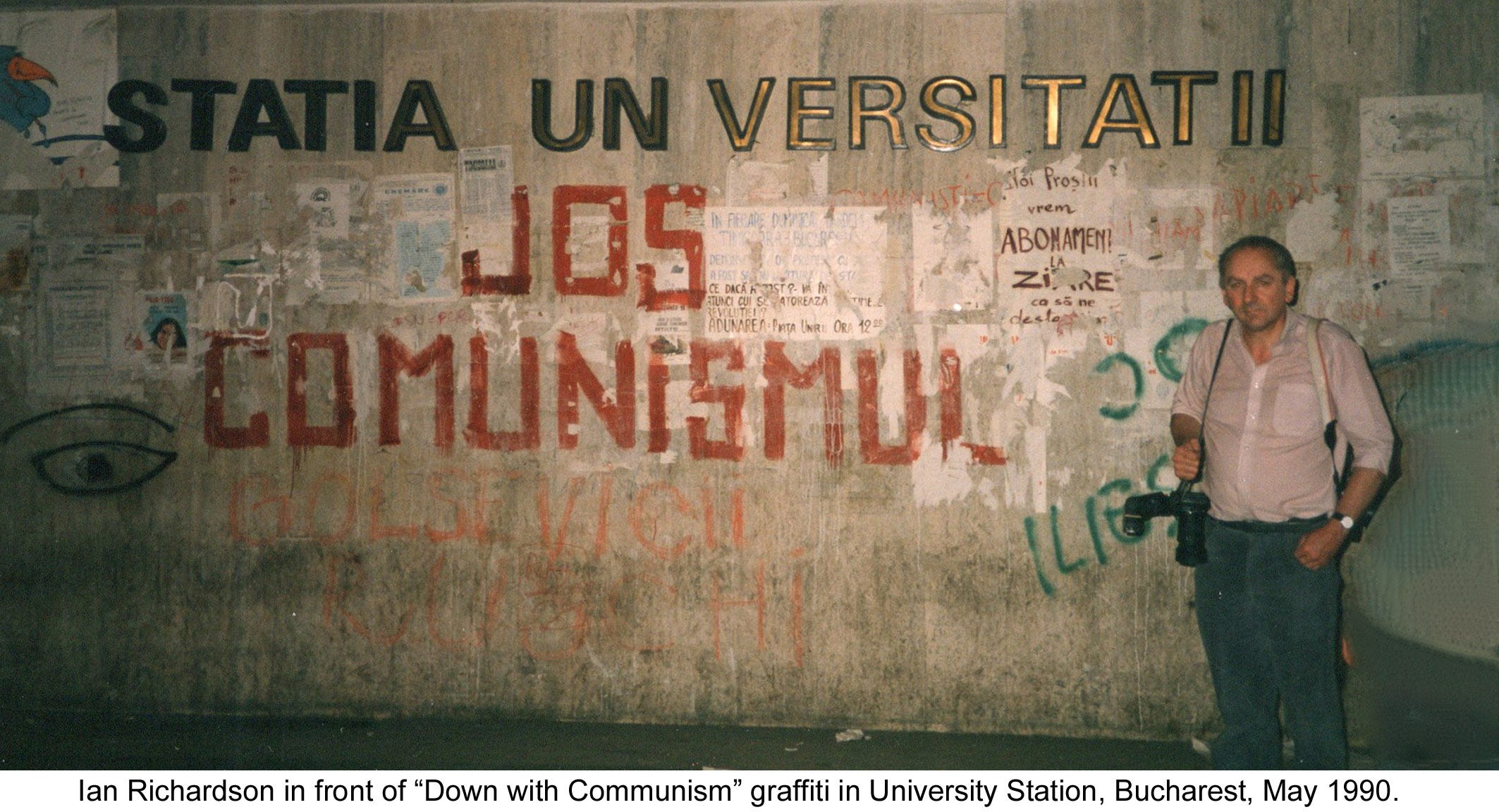
The hotel overlooks University Square, which was taken over by an anti-government demonstration that had already been going on for two weeks. It was quite interesting and reminded me in many respects of the pro-democracy demonstrations I saw in Peking, though having nothing like the scale. I guess there must have been 10,000 people there, listening to speeches and entertainment. (In Peking, the demonstrators peaked at close on one million.) There was a real cross-section of people, as in Peking. Members of the crowd would intersperse their cheers and chants with comments of their own. The general drift of the demonstrators’ argument was that the government was really the ousted Ceausescu regime in sheep’s clothing. Despite their complaints against the government, it must be an exhilarating experience to be able to take part in such a protest after all those years of living in a vicious totalitarian state. As recently as last December, demonstrators were simply shot where they protested.
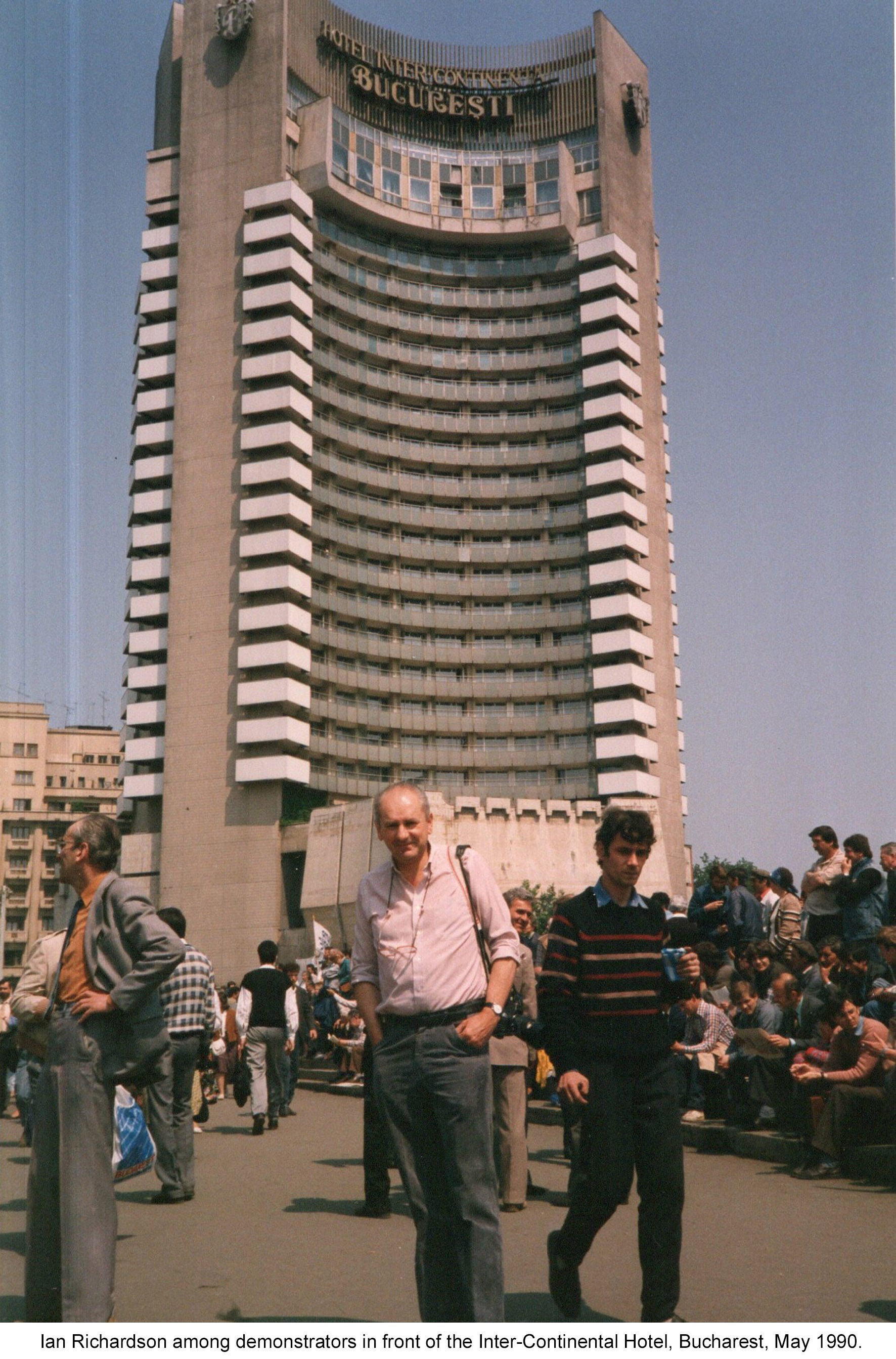
As well as actually moving among the demonstrators, I was also able to watch and listen to them from my balcony on the 14th floor. The night time view is very un-city like, chiefly because there are so few lights. It looks almost like a city under blackout, though I am told that these days the power supply in central Bucharest is at least reasonably consistent. I see that my hotel room is equipped with a candle, just in case. Outside the city centre, both power and water supplies are subject to frequent and sometimes protracted cuts.
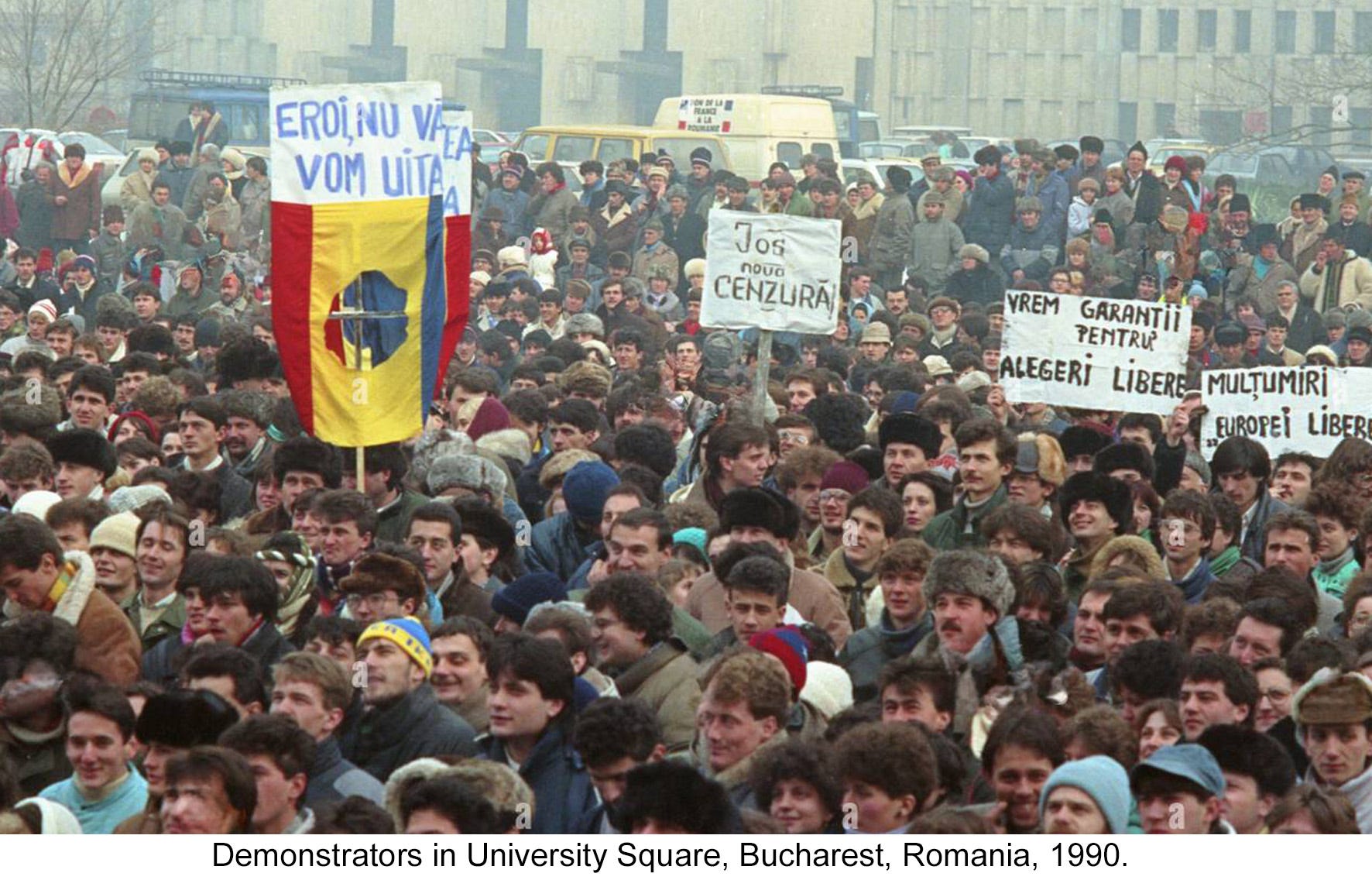
Daylight revealed only a hard core of demonstrators. There was a small tent city in the square, and there were anti-government signs draped over several of the buildings. But once the working day was over, the demonstration was once again in full swing.
The food in the hotel is quite good, and the guests are clearly privileged. For the ordinary Romanian, the food shortages are almost as bad as in Moscow. A queue forms as soon as something becomes available in a shop, and the queue itself attracts further people. The view, understandably, is that what is available today may not be available tomorrow -- so buy now! Once in the queue, the wait can be long. Our correspondent in Bucharest says a three-hour wait in a queue just to buy one chicken is not at all unusual. One result of the shortages of food and other consumer goods is that many Romanians have surplus cash with nothing to spend it on.
One of the most grotesque projects of the Ceausescu years is his massive palace looking along the Victory of Socialism Boulevard. A huge swathe has been cut through the old part of central Bucharest to build the avenue, lined by flats and office blocks that now lie uncompleted – and are likely to remain so for many, many years. A whole section of the city skyline is dominated by cranes that had been working on the avenue. A pretty part of the city not just been wiped out, but it has been replaced by something that the country did not want, nor could afford. While the people starved, Ceausescu regime shovelled huge sums of money into grandiose building projects.
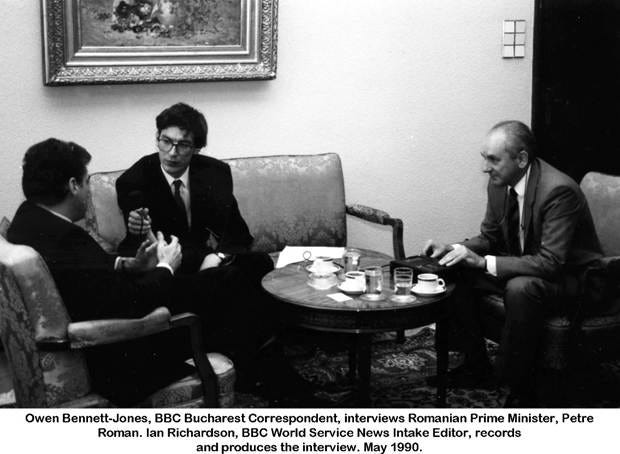
The first free elections take place late this month. Most people seem to accept that Romania will stay a relatively free country, though there are still a substantial number of people who worry that the Securitate, Ceausescu’s armed secret police, could once again terrorise the country. The National Salvation Front, which took over after the revolution in December, is extremely confident of winning the elections by a large majority, though opposition figures are convinced the Front is run by old style Communists, though you wouldn’t know it, assuming it is true, from meeting the Prime Minister, Petra Roman. My visit to Bucharest was used as a reason for pushing for an interview with Roman by our correspondent, Owen Bennett-Jones. Maybe it was my suit that did it, but we scored an exclusive interview that provided quite a good story. Roman was a young, confident and photogenic man who spoke good English and was well able to handle even the trickiest of questions.
Roman’s official spokesman was a pretty slippery customer who seemed desperate to ingratiate himself with me, mainly, I suspect, because he was angling for an official invitation to visit the BBC World Service, something that would mean he could travel to Britain. Despite my reservations, lunch with him proved to be very interesting as he explained away, with only part success, how he managed to be a Ceausescu man one moment and a revolutionary official the next. One thing that emerged from the conversation was Ceausescu was totally paranoid about anyone with relatives abroad. Roman’s spokesman said he had once been accused of being a traitor by the Securitate, simply because a grandparent had been born in Russia.
My hotel seemed to be crawling with prostitutes after about 6pm – attracted, no doubt, by all the journalists and businessmen awash with hard currencies. Three of them hopped in the lift with me one night, and by the time it had reached the 14th floor, they had made a variety of interesting suggestions about how I could spend the rest of the night with all three of them. I suppose you could call it a job lot offer. I lied that I had my wife with me and they gave up in disgust.
On my final afternoon in Bucharest, I hired a young university student to show me around the city. He spoke excellent English, having lived for five years in the United States when his father was posted there to work on a joint venture mining project. He was very interesting and turned out to be a very keen and well-informed BBC listener. It makes all the difference in a place like Bucharest if you have someone to show you around and translate for you. It was excellent value for $US3O. We visited all the main sights, plus the scene of much of the fighting during the revolution.
I was taken around Bucharest’s main department store. It was rather like being at a closing down sale in a warehouse. It was very gloomy, scruffy and spartan inside. The concrete floor was covered with a kind of rubber matting. The clothes were displayed on racks with no sense of presentation or style. The quality of the goods was, on the whole, pretty poor. Certainly, I was not tempted to buy anything. Many of the smaller shops appeared to have very little in them. There was a queue outside one shop for tennis shoes.
I had trouble getting my ticket confirmed for my flight from Bucharest to Belgrade, so the Prime Minister’s press secretary just rang up the transport ministry and ordered that I be put on the flight. Nothing like knowing the right people!
By the time I left Bucharest, I had just about had enough of the demonstration in the square below my hotel room. Each day it went on until after lam and resumed again before breakfast. Even during that short break, music was played over the loudspeakers. Fortunately, I had double glazing on the windows, but this did not do enough to keep out all the noise.
My flight to Belgrade was scheduled to leave just before 7am, which meant rising at 4.45am – not a time I am at my best, specially when I don’t get to sleep before midnight. Check-in, customs and immigration took an eternity, and I was still having my passport checked at the time the plane was due to depart. The flight was in a Russian-built Ilyushin 18 propeller-driven aircraft. It was incredibly noisy – even worse than the luggage carousel at the airport. Happily the flight lasted only an hour. Many of the passengers clapped when the plane finally touched down in Belgrade. I don’t know whether this was from a sense of relief or whether they were applauding the crew for having completed another successful mission.
Belgrade airport was much more modern and cheerful than I have come to expect in Central/Eastern Europe, but my first impression of Belgrade as I was driven into town was the terrible pollution. The BBC’s local correspondent, Jim Fish, was quite surprised by my observation; he said it was an unusually clear day for Belgrade. He said you could even tell the sky was blue.
My hotel was the Moskva, an old fashioned and quaint, if not eccentric, hotel. My room was spacious and split level, with the bed and bathroom up some stairs on a mezzanine floor.
Belgrade is a kind of halfway house between a socialist and a capitalist state. It is still officially Communist, but may not be for much longer, after the imminent elections. The shops have an abundant range of goods, but they are very expensive by London standards. Belgrade was very heavily bombed in the Second World War, but much of the centre has been re-built in the old, attractive style. There is also a lot of modern building, some good and some not so good, but that is by no means unique to Belgrade.
Yugoslavia has made a remarkable turn-round on the inflation front. After a very dangerous period of hyper-inflation, the government is now claimed a small deflation rate. A substantial residual problem is the quantity of paper notes required for even a small purchase. It is an easy – if not unavoidable – achievement to be an old dinar millionaire with one modest visit to a money changer. A D100,000 note is the equivalent of just 50p. The government devalued the currency by simply stripping four zeros off the value of the currency, and is progressively replacing the old dinar notes with new ones, but this seems to have just added to the confusion. The solution for a great many Yugoslavs is simple: they identify the notes by their colour, rather than their face value. Hence, you will be told that an item you wish to purchase costs, say, “four red ones” (about two pounds sterling).
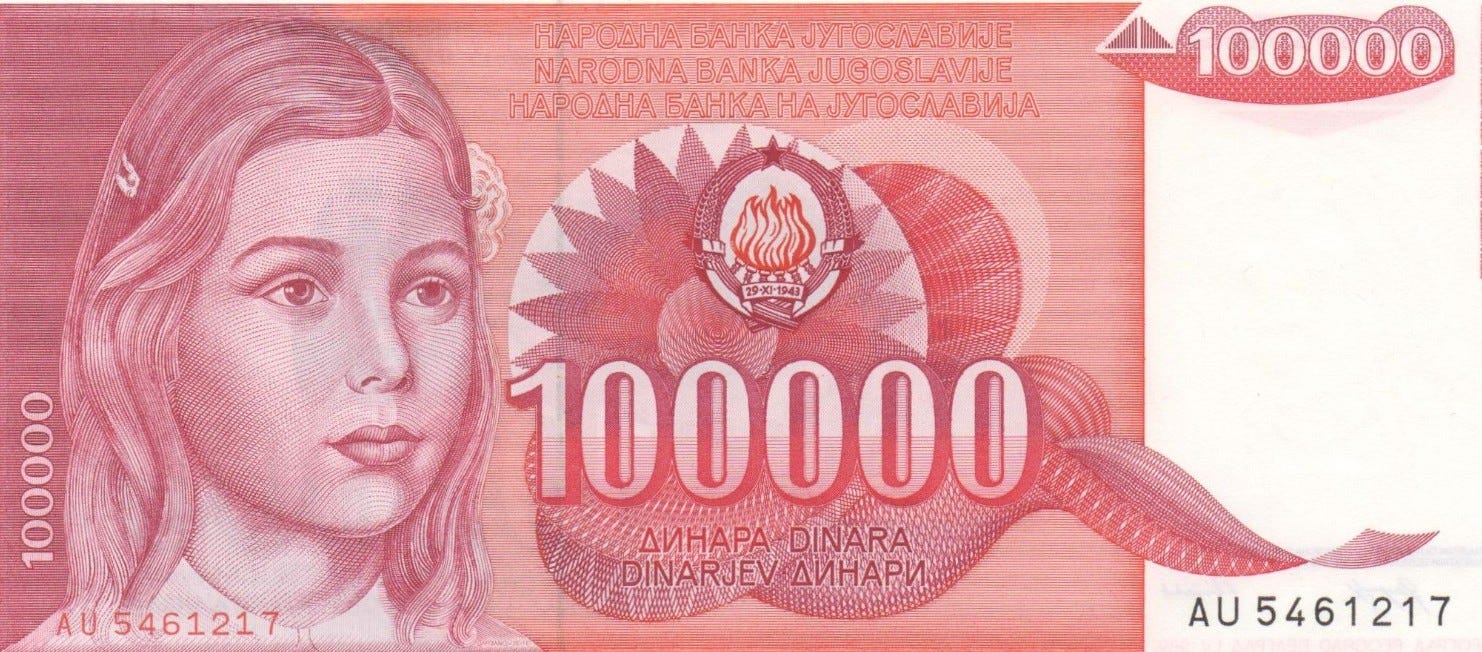
The local currency can cause problems when it comes time to leave the country. It can be a difficult balancing act, because you can’t change your excess dinars back to hard currency at the airport. It is therefore easy to find yourself leaving the country with a wallet choked with useless banknotes. With this in mind, I ran down my stock of dinars, but came unstuck when the hotel seriously under-estimated the cost of the taxi fare to the airport -- and compounded this error by failing to tell me I needed D100 Departure Tax. This left me with no choice but to pay my fare with a $US2O note, effectively giving the driver a 50% tip. This experience further reinforced my discovery in Bucharest that life is made much easier by keeping a wallet full of small denomination dollar notes.
Both Romania and Yugoslavia have a gypsy problem. In Bucharest, the gypsy community appears to provide most of the professional child beggars, and there is an intense hatred of gypsies. This feeling isn’t so strong in Yugoslavia – perhaps partly because there is less emphasis on the begging/criminal side. A substantial number are gainfully employed or work as street entertainers, but I did see one pathetic little girl, probably aged about three, squatting on the pavement and begging for money. As she sat there with a heap of near-useless notes in front of her, she ate a small bag of strawberries. I could see no-one standing in the background watching over her and Jim Fish said her parents had probably remained at home after sending her out onto the streets. The gypsies can also be an irritant at traffic lights, insisting on washing car windscreens. Drivers who protest too strongly and/or refuse to pay for this service are in danger of having their paintwork scratched.
It is interesting to observe that while we in Britain, and in the BBC in particular, agonise over whether people should be allowed to smoke in offices or public places, no such questions seem to pass through the minds of the east and central Europeans. The overwhelming majority smoke, and I did wonder how much this added to the pollution problem in the cities. Imagine the column of smoke if a million cigarettes were placed in a heap each day and set alight!
Superficially at least, central Belgrade looks much like any prosperous western European city. People are well and fashionably dressed and the shops are well stocked with the sort of goods you would find in cities like London, but the cost of living is very high. Jim Fish’s wife, Maja, said eating out and taxis were cheaper than in London, but most other things were about 50% dearer.
FAMILY NEWS
Finally extracts from a letter to my family dated June 16, 1990:
Somewhere in what passes for my files in my upstairs office (actually a great heap of assorted papers, at the moment), I have my incomplete notes on the earlier visit to Czechoslovakia and Austria. My latest visit to Washington/New York went off well and was very interesting, but I have had enough travelling for the moment. The worse thing about these trips is that the office paperwork back in London relentlessly accumulates as a form of punishment for enjoying yourself. The only trip on the horizon for the rest of the year is a return visit to Moscow for a Summit projected for early December. Like the previous summits I’ve been involved in, it is quite likely that I will not get to see either of the protagonists. However, on my visit to New York, I did get to see Henry Kissinger, New York Mayor Dimkins and Israeli ambassador Eban at a function at the United Nations. Small compensation for not seeing Gorbachev or Bush.
Still on the work front, big things have happened. It was decided this week that my boss should move to another job for six to nine months. He will be acting Managing Editor. I will become head of News Intake for that period. It means I am line manager for all the BBC World Service correspondents. It should be very enjoyable, though some of the things I would like to change cannot be done while there is a chance my boss will return to his current job at the end of his attachment. Coinciding with this news, I moved into my new office at long last. I have had to wait two years to get it, but it was worth waiting for. In fact, I have the best office of anyone in the News Department. It was luck rather than good planning, but I ended up with a nice view of The Strand. My boss has a very gloomy office looking out onto a car park.
That’s it for this chapter.
Other chapters of can be found HERE.