

Chapter 62: Fascinating work visits to Thailand and India
Early 1987. Mostly about teaching BBC journalists how to improve the quality of their reports back to London. Also revelations of life in Delhi.

This chapter draws on notes made on my way back to London from a holiday in Australia.
Sydney, January 15 1987:
MEETINGS
During a brief stop-over in Sydney I met the bigwigs of the Australian Broadcasting Corporation news and current affairs department. I had been asked by my BBC World Service bosses to find out what I could about the ABC and their use of BBC material. But I gained little information because the ABC executives were more interested in knowing about my work improving correspondents’ communications. I was surprised and flattered to know my name was familiar to them.
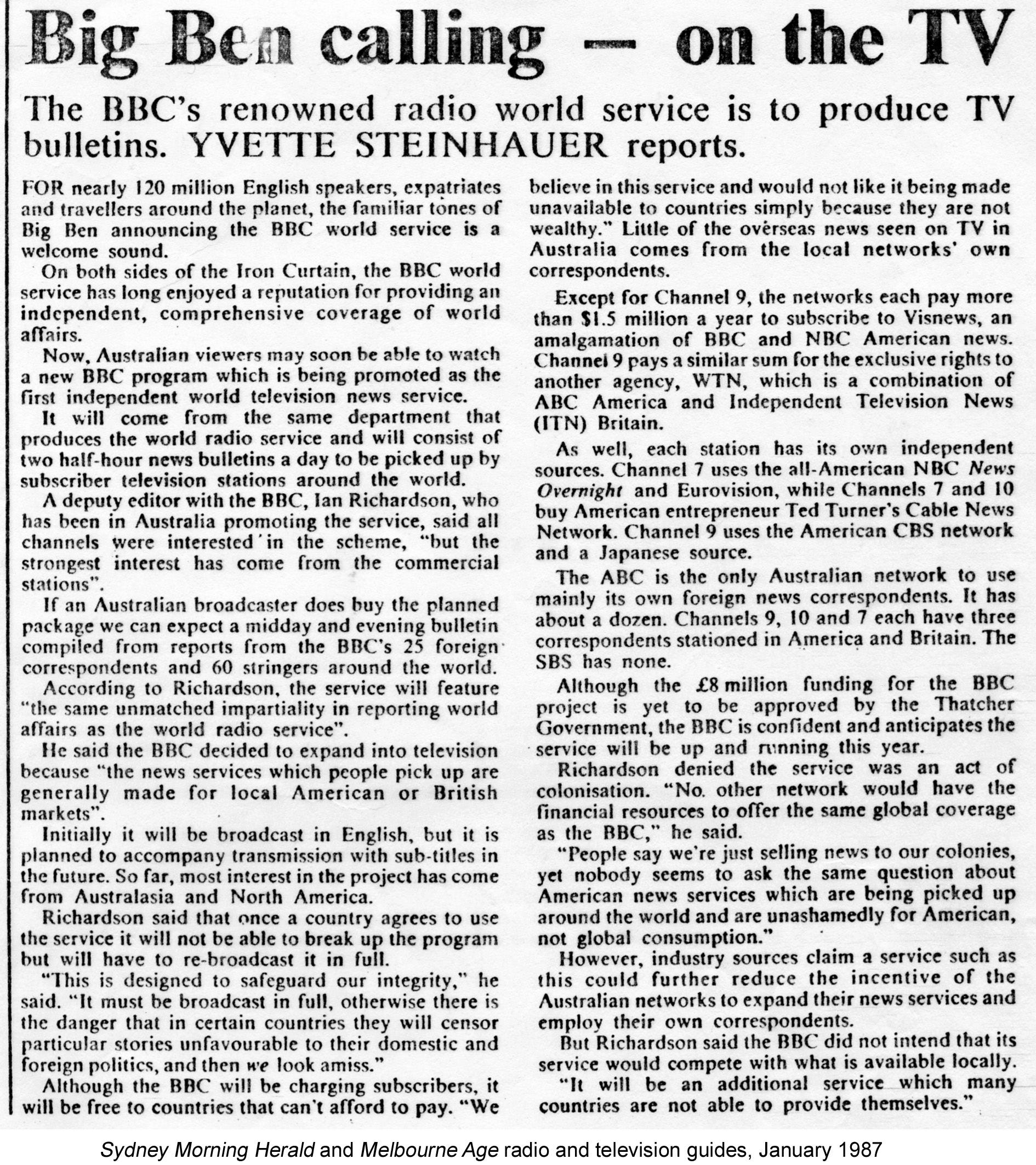
Next was a rushed interview on the World Television Project with a girl from the Sydney Morning Herald guide on radio and television. She didn’t seem to know much about TV and was of the “gis a quote” school of journalism.
However, I was quite happy with the article. Unfortunately, for many complicated reasons, I was rather ahead of events. BBC World Service Television News didn’t get on air until 1991:
ANOTHER MEETING
I went to the British Tourist Authority for a brief but very useful meeting with the Manager, Gareth James. He was very positive about the London Home-to-Home pamphlet. (The only criticism was that “bed and breakfast” wasn’t sufficiently emphasised.) He liked the true representation of the sort of houses that were on our books. Too many people, he said, had been led by other b&b organisations to believe that they would be staying in quaint thatched cottages. He and his offsider, Angela, were well aware of LHH and its good reputation. They were anxious to get more Australian journalists to stay with LHH. He said Rosemary and Anita had never let the BTA down.
ENGINE TROUBLE
The flight to Bangkok via Melbourne and Singapore got off to a bad beginning when one of the engines refused to start. It was 45 minutes before the mechanics made the necessary repairs. I guess it is a sign of the growing sophistication of modern aircraft and the modern traveller that the breakdown of an engine is more an irritation than a cause for alarm or panic.
TECHNICAL TRAINING
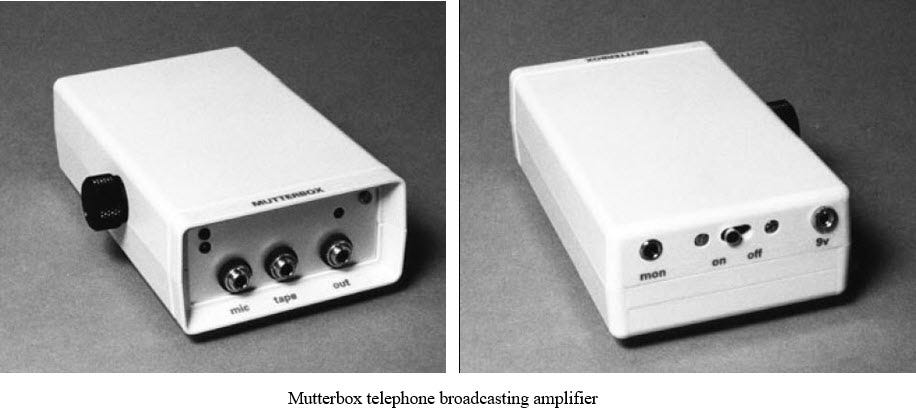
A prime reason for the stop-overs in Thailand and India was to train BBC correspondents and their producers in the use of the “Mutterbox”. This is a small super-clever device manufactured to my specifications by a super-clever Australian engineer, Gavan Kelly. Its purpose was to improve the quality and strength of reports over telephone lines, particularly those of a poor quality:
THAILAND STOPOVER
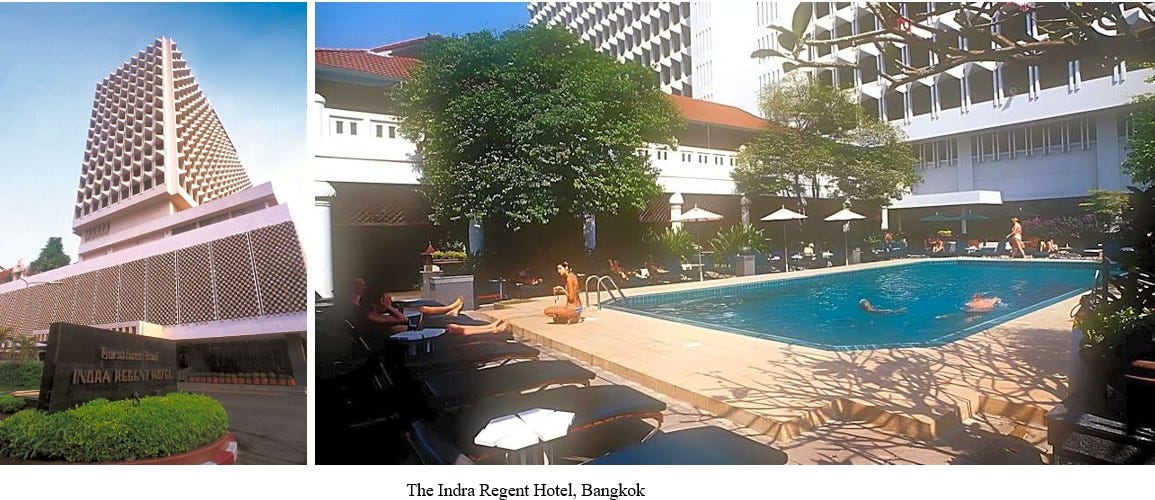
The plane reached Bangkok shortly before midnight local time. It took me nearly 2-1/2 hours to go through all the procedures and reach my hotel, the Indra Regent. This was largely due to the fact that the airport is in the middle of being re-built. Although it was about 2am when I reached the hotel, all the street markets were still busy.
I slept to about 8am, got up for breakfast, then went back to bed for a few more hours between the blankets. I was still a bit jet-lagged, but a swim in the hotel pool freshened me up before I met the BBC South East Asia Correspondent, Peter Nettleship, and our Australian local stringer, Neil Kelly, for a pleasant poolside lunch. The weather was sunny and warm; the food was good and cheap.
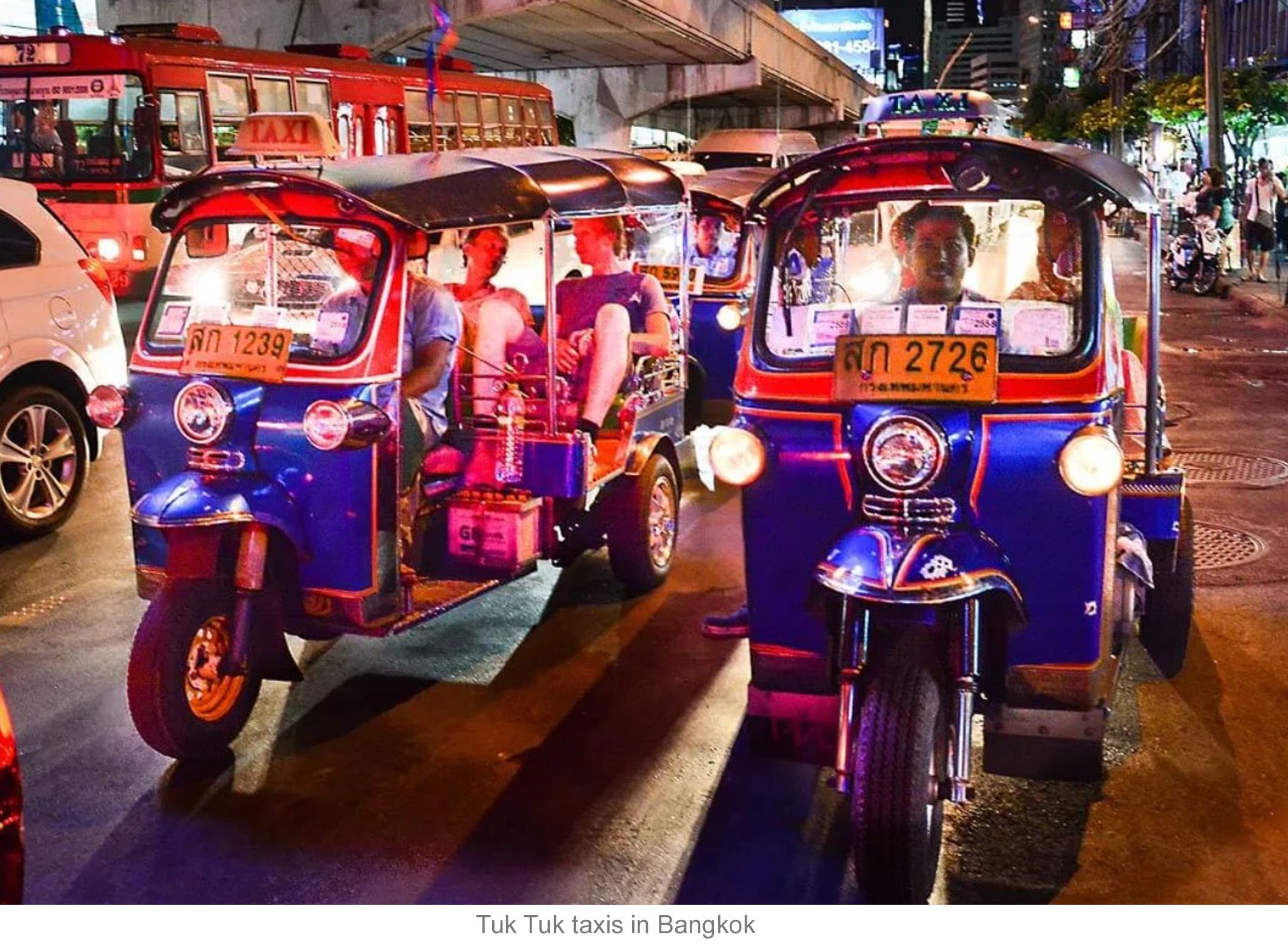
After lunch, Peter and I went visiting some people, travelling in a Tuk Tuk. This is a three-wheeler, open-sided taxi. Tuk Tuks, which get their name from the sound made by the engine, are cheap but often hair-raising in the way they dart every which way through the traffic. Apart from the ever-present prospect of being involved in a collision, the other drawback was the fairly frequent experience of being engulfed in clouds of diesel exhaust fumes from passing trucks and buses. Still, I found the Tuk Tuks exhilarating.
By the time I returned to the hotel I was feeling pretty jet-lagged again, but went for a stroll around the neighbourhood street markets. I found them fascinating. All sorts of food was on offer, much of it cooked while the customers waited. I was told that most of the cooked food was safe to eat, as long as it wasn’t served on plates, most of which were washed in a couple of buckets that only occasionally saw clean water. The rest of the stalls offered the usual watches and electronic goods. Many of them carried famous brand names, but were probably fake. There were a few fortune tellers offering their services.
Saturday, January 17 1987:
I had hoped to go with Peter Nettleship to the Kampuchean border to see the situation at the refugee camps, but in the event it wasn’t possible to get the required passes. So instead we decided to make a trip to Ayutthaya, the former capital of Indo-China. This meant getting up at 6.30am, which as you well know, is somewhat earlier than my ideal starting time for launching myself into the great wide world.
We went to Ayutthaya by bus, passing through terrible smog as the sun fought its way through to us. The suburbs of Bangkok were pretty drab with lots of concrete buildings, but the view improved considerably once we got clear of the urban area.
The countryside was very flat and mostly used for growing rice. The peasants were bringing in the harvest, cutting each handful of stalks by scythe, then placing them in heaps to dry. It is a very labour-intensive way of farming. Most homes were of wood and built on high stilts to keep them above the water during the monsoons. The area is only about a metre above sea level, so the water table is very high.
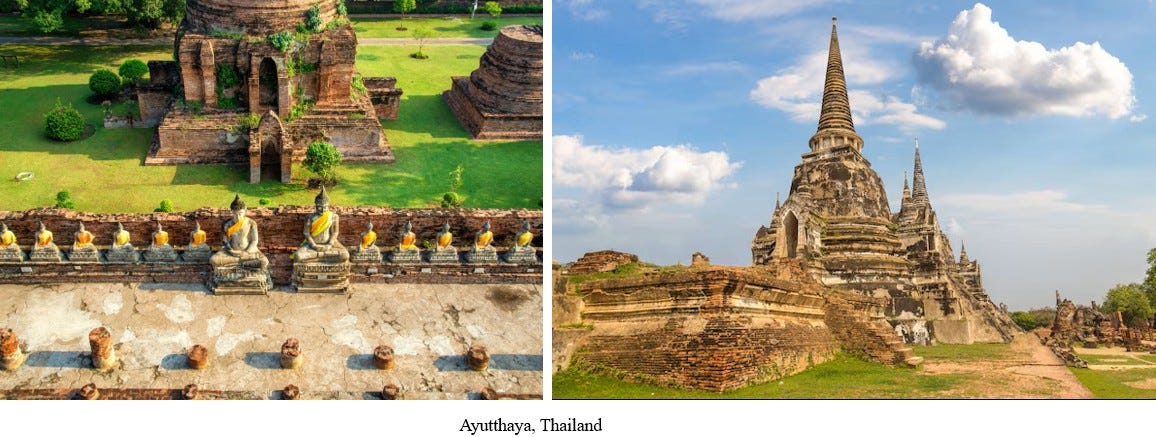
The main attraction of Ayutthaya is its ancient temples and the Royal Summer Palace. The temples, some of which are still in use, were fascinating. They were mostly built of handmade bricks although some had wooden frames, even though they dated back to the 12th century.
As with yesterday, the weather was pleasantly warm, and this was much appreciated for the return journey to Bangkok, made by riverboat.
The boat was very large and must have carried a couple of hundred passengers. First we were served a generous and enjoyable lunch, then we went upstairs to enjoy the view during the remainder of the four-hour trip.
Sunday, January 18 1987:
I had a wonderful 12-hour sleep and seemed to have shaken off the jet-lag just in time for my next flight and time change!
Most of the afternoon was spent giving Neil Kelly some “Mutterbox” training, before I set off for the airport and a diversionary working visit to Delhi.
At the airport I found that my Air France flight was more than an hour late -- then to rub it in, I was done for excess baggage. This time I had really pushed my luck too far: the main bag weighed 44 kilos and my cabin bag 10 kilos. Fortunately, they decided to charge me for only 5 kilos, which the BBC has to refund. Whether having paid excess baggage had anything to do with it, I do not know, but when I went to board the plane, I found that I had been bumped up to Business Class. This almost made me revise my opinion that Air France is a very so-so airline.
I have never flown Business Class before, but I am sure that I could grow accustomed to it. There is more space and you get footrests and a travel pack that included an eye mask, a toothbrush and paste and a razor. The other touches included real headphones (instead of the cheap plastic junk in Economy), caviar and unlimited champagne. It was all very nice, but it is arguable whether these touches are worth the extra money on a short flight.
When you travel with a second-rate airline such as Air France you really appreciate airlines like Qantas. During the 3-1/2 hour flight to Delhi the passengers were given almost no information, whereas Qantas would, at the very least, have given the local time, the local weather and tips about the transport available from the airport.
INDIA REVEALED
The plane reached Delhi just before midnight. The airport is modern and seemed efficient. But trouble began when I tried to get a taxi into town. I approached the official tourist desk to get a pre-paid taxi and was told I could have one for 90 rupees (about £5.40). After the official filled in what seemed like endless paperwork, he took me outside and tried to put me on a BUS (the cost of which I later discovered was 10 rupees!). A blazing row then ensued, with the official trying to tell me that “the bus is better than a taxi” and me telling him that he was trying to rip me off. I finally demanded, and got, my money back.
My worst memories of Delhi from the time Rosemary and I stopped over there in 1968 were being relived. And worse was to come. Having avoided one rip-off, I went to a desk manned by a policeman who was supervising the taxis. I told him what I wanted and he allocated me a “pre-paid” taxi. But when I tried to establish the cost, the copper kept repeating “the taxi will tell you”. As this debate went on, two chaps were hurriedly loading my gear into their taxi. When I went over to find out what the hell they were up to, I was told that they were taking me to the hotel and that everything would be all right.
As soon as I climbed in, I demanded to know what they intended charging me. Instead of answering, they accelerated away from the kerb. There was much shouting on my part and finally I was told that the fare was 150 rupees. I said I would not pay, but didn’t pursue the argument as the taxi was now rattling down the darkened highway at 2am in the morning with two hooded Indian gentlemen in the front seat.
The taxi was an Ambassador, the standard vehicle in India. It is locally manufactured but is in reality a 1956 Austin car under another name. The boot was so small that it could only take one case. The back seat had room for just two people or in this instance, my small case and me. The vehicle was very battered and made an awful noise as it rattled along the road. The exhaust had fallen off and the vehicle was full of fumes. It was like a journey into hell. Eventually we arrived at the Imperial Hotel where I told the commissionaire what fare was being demanded. He assured me that 150 rupees was correct, so I gave up and paid. (He was lying. I later discovered that the fare was about 60 rupees, plus a 25% late night charge. I was later to learn that the cops and the hotel commissionaires all take their cut from rip-off taxi fares.) The hotel was a leftover from the Raj. My room was spacious but fairly spartan and very gloomy. I don’t think there was a light globe more powerful than 40 watts.
Monday, January 19 1987:
I awoke to a thick fog and temperatures cool enough for a jumper to be necessary. Having had a chance to looked about the hotel, it hardly justified its “Imperial” title, but it seemed clean enough with reasonable facilities. The biggest initial problem was getting hot water for a shave and shower.
Breakfast was watered-down fruit juice, fried eggs and cold bacon. After that I caught a taxi to the BBC office. Our bureau chief, Mark Tully [not yet knighted], is so well known in India that all I had to ask for was to be taken to “Tully House, BBC”.
Delhi in the cold light of day was just as I remembered it from the last visit: an utterly poverty-ridden, dirty shambles. If you haven’t been to the city it is hard to appreciate just what the place is like. But just imagine the centre of Melbourne with every building in need of a coat of paint, shacks and tattered tents on every footpath and open fires everywhere as people cooked their food. Imagine, too, every car being a battered 1956 model and an almost constant smog caused by petrol fumes and open fires.
The BBC office was in what is considered to be a plush street, but it is beside a rubbish tip and people seemed permanently camped in the streets in the close vicinity.
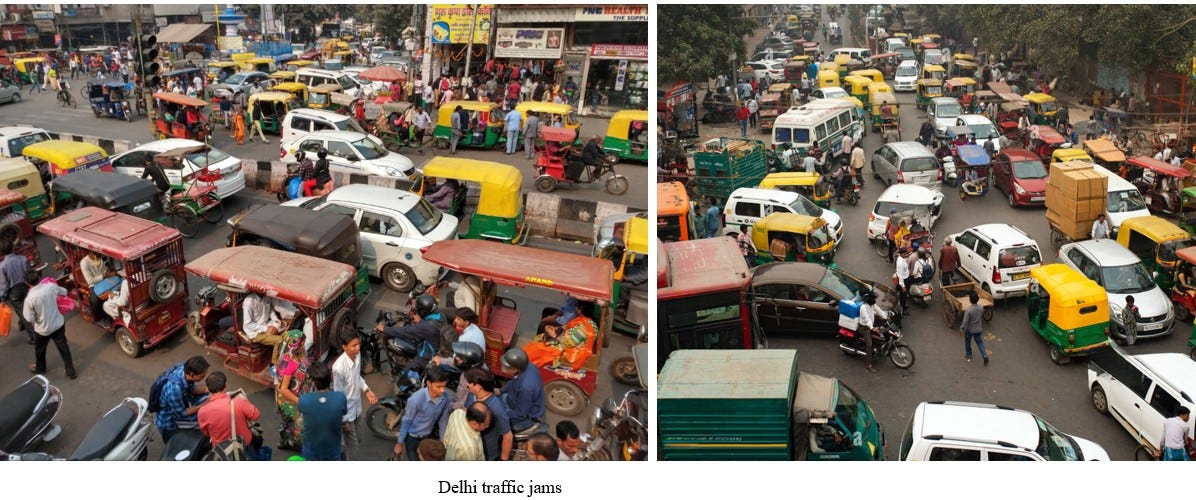
The streets of New Delhi are very wide, but the traffic is quite chaotic. Hardly any driver in Delhi has had proper lessons or done a driving test. All anyone has to do is approach a fixer outside the Transport Ministry building and pay the equivalent of £1.50 for a forged licence. A recent survey showed that 70% of drivers in Delhi had no idea of the traffic regulations. Believe me, it is quite an experience to get into a taxi that heads off diagonally against the oncoming traffic until it eventually reaches the correct side of the six-lane highway. It is terrifyingly common to see bikes, rickshaws and even cars travelling in the wrong direction in the fast lane of a highway. Delhi is said to have an appalling road accident record. With the way people drive that ought to be the case, but amazingly I saw no evidence to support this.
At the BBC office, one of my initial tasks was to examine the antiquated telephones installed there. Of all the BBC bases around the world, the Delhi office has the worst record for the low technical standard of correspondents’ reports filed over the phone. I quickly ascertained that the problem primarily lay with the actual lines from the exchange.
Mark Tully announced that he was going to have to fly to London because his father was very ill, so his locally-recruited deputy, Satish Jacob, took me under his wing.
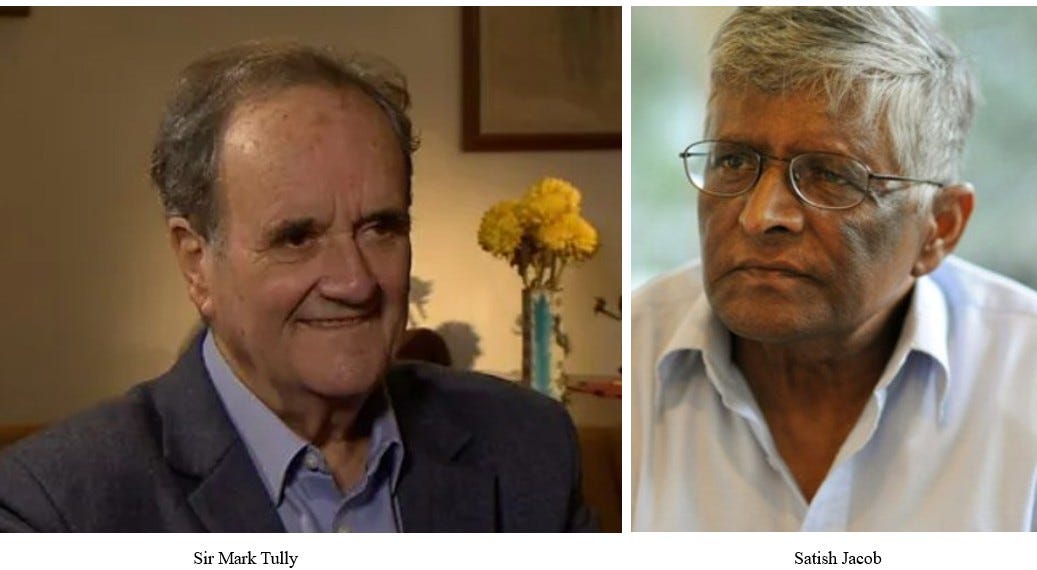
Satish took me off to lunch at the Delhi Press Club, said to be the hub of intellectual and journalistic activity in India. Maybe, but it was a very grubby, battered building and the meal I had of curried mutton and vegetables was of indifferent quality. The local lager was also very so-so and made me long for a cold Fosters. Still, Satish proved to be charming, intelligent and witty company.
The afternoon was taken up with various discussions about the technical needs of the bureau, then it was back to the Imperial for the evening meal. I chose a very tasty fish tikka which, accompanied by a beer, cost me the equivalent of just £3. The restaurant, on this occasion at least, was rather amusingly lacking in atmosphere. Throughout the meal a carpenter was up the other end of the room enthusiastically hammering and sawing. It could only happen in India.
Tuesday, January 20 1987:
I was up for an early start and found this morning’s breakfast bacon hot. Satish picked me up at the hotel to take me on a trip into Haryana State. The trip was being made because a visiting BBC World Service producer needed to gather interviews and actuality sound for a special programme to mark India’s 40th anniversary of independence. So a BBC commentator, who was also also visiting India, and I went along for the ride.
It was a lovely day, sunny, and about 70 degrees, marred only by the sight of the dreadful tent cities and slums, as we drove out of Delhi into the countryside. Crude signs were displayed every half miles or so offering “Abortion by Machine”.
Once clear of Delhi, its slums and its smog, we found ourselves in the very green and pleasant countryside. Haryana State has been leading the “Green Revolution”, a campaign to introduce small-scale irrigation and other agricultural schemes. In many of the fields we saw monkeys and peacocks roaming wild.
Traffic on the roads was a mixture of cars, trucks, buses, rickshaws, bicycles, ox carts, donkeys and camels. As with Delhi, there was little or no order in the traffic flow. It was every man and vehicle for himself.
We stopped every so often to do recordings. The locals tended to ignore us as we went about our work. Electricity supplies in rural areas are very patchy and many areas have no telephones. Hygiene tended to be even more appalling than in Delhi. We visited a sweet factory beside the road and found that the sugar was boiled down in open tanks, into which all sorts of unattractive bits and pieces appeared to have fallen in.
The main engagement of the day was a visit to the Haryana State Agricultural University, about 100 miles from Delhi. We were feted there, then escorted by jeep to a village which had not long ago installed its own irrigation scheme.
This was fascinating. If the two motor vehicles had not been there, the scene would have been straight out of biblical times. It was extraordinary. All the men and children in the village turned out in force to meet us as word got around that we were from the BBC. One man came running up to us with a letter he had just received from the BBC Hindi Service in London. We were told that 60% of the villagers listened regularly to the BBC. Though this sounds an unbelievable figure, it is not so surprising when you consider that the BBC has a daily audience of 60-million people in India.
While we were escorted to the irrigation fields, the women, some in purdah, stood shyly at the entrances to their homes.
I had a look inside some of the buildings. Most rooms appeared to be communal ones, even to the point of having the family cow curled up on the floor in front of the fire!
The sun was going down as we left the village and headed back to Delhi, considerably behind schedule. As we got back onto the main road, Satish remembered that he had promised to take his wife to a concert that evening. Some hope as we were still close on 100 miles from Delhi!
The trip back was hair-raising. There was little or no street lighting and the vast majority of the vehicles on the road were also unlit. At one point we almost rammed the back of a massive haycart taking up the entire width of the road and devoid of any lighting.
About halfway back we stopped at a government tourist restaurant for a meal. It was about the only place in the area where you could eat the food with any safety. Satish ordered a very nice dish of cheese dipped in spicey batter and deep fried.
As time was getting on, Satish became rather concerned that his wife and the office would begin to worry about us, but there were no public phones anywhere - not even in one “town” of 2.5-million inhabitants barely 50 miles from the capital.
Eventually we made it back to Delhi without running down anyone or crashing into another vehicle. We arrived at the office to find that urgent enquiries were being made with officials in Haryana to try to see if we had come to harm. And as Satish had feared, his wife was both worried and very angry. Mark Tully poured us all several large whiskies and eventually sent me back to the hotel almost legless.
Wednesday, January 21 1987:
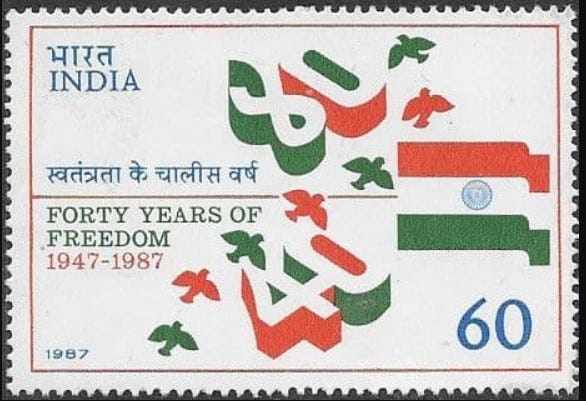
After a good sleep, I awoke to another glorious day. I took a roundabout trip to the office to see some of the preparations for the 40th anniversary of Indian independence. There were police and soldiers everywhere, with whole parks taken over by personnel carriers, tanks and missile launchers brought to Delhi to take part in the parade. There were special postage stamps to mark the anniversary. Here’s one:
Most of the day was spent on “Mutterbox” and other technical training. I was constantly reminded of the illogicality of the BBC spending over £100,000 a year on the Delhi office, with a miniscule proportion going on the vital matter of communications. Fortunately, money is now going to be made available to buy some decent phones and audio equipment.
In the evening I had an interesting chat to Jennifer Jaffrey, wife of a fairly well known London-based Indian actor, Saeed Jaffrey. She had fascinating stories to tell about how Indian films were made (or thrown together). To prevent story ideas being stolen, actors were rarely given scripts in advance of shooting. Even when shooting began, the actors and crew had only a vague idea of the storyline. Jennifer said that the actors often had to work off scribbled sheets of paper for a scene, or were told to ad-lib their way through.
Thursday, February 22 1987:
More training today, but mostly spent seeing telephone officials in an attempt to get something done about the dreadful service from the BBC office.
It was a most instructive day. The Indians do nothing unless approaches are made through the “proper channels” and strings are pulled. So Satish traded on his high profile in India to make contact with the second-division officials. Once that hurdle was overcome, he then leaned heavily on them for a meeting with the General Manager, telling them that “a very important man from the BBC had flown here to try to find out why the telephone service is so bad”. Three hours later we had a meeting with the man himself.
It was not so much a meeting as an event. Satish and I played a two-handed game, with Satish forelock-touching in my direction all the time to impress on the General Manager just how important I was, while I expressed the deep embarrassment of the BBC that the quality of its correspondents’ reports from Delhi showed up so badly against those from Pakistan and Bangladesh. This really stung the General Manager into a theatrical performance to demonstrate that his phones could be as good, even better, than those in the upstart neighbouring countries. He was shouting down the phone at underlings and had the District Engineer summoned to the meeting and trembling in his shoes. He rabbited on about how he was using meditative techniques to get the best from his staff and suddenly demanded of his District Engineer: “Have you been doing your meditation?” “Oh yes sir,” he replied nervously, “and I am now feeling much better”.
The upshot of the meeting was that by the time we got back to the office, the place was swarming with telephone engineers. Not that they were able to put everything right straight away, but as the Indian telephones have been a thorn in the side of the BBC for a couple of decades, I felt that things were at last starting to move and that Satish and I had done a good day’s work.
In the evening, Satish took me to his home in Old Delhi to meet his family and to install a new telephone plug for his equipment. It was in a dangerous state with bare electricity wires in the plug, alongside the telephone connection. I fixed that. Then I went out to dinner with Mark Tully’s secretary and a BBC Foreign Duty Editor who was on a private visit to Delhi. It was a very enjoyable meal, much of it eaten with my hands. I became quite used to meals without a knife, fork or spoon. The only real drawback was that if the food was highly spiced my fingers turned yellow.
I was taken back to my hotel about 11pm, expecting to be leaving soon after for the airport to catch an overnight flight back to Bangkok. But a message was awaiting me to say that the flight was 10 hours behind schedule. Fortunately I hadn’t booked out of the hotel, so I was able to stay put and get a good night’s sleep.
Friday, January 23 1987:
I awoke to find that my Thai International flight had made up an hour, so there was no time for breakfast before checking out and heading for the airport in a time-warp taxi.
At the airport I was nearly done again for excess baggage. This time they wanted to charge me for at least 10 kilos but I was finally let off when they discovered that they couldn’t accept the credit card I offered.
By way of a farewell from India, I was subject to three incidents that sum up the frustration of life there. Before my ticket could be issued, I had to pay the airport tax at another counter. I queued up with a number of other people, only to be ignored by several officials chatting among themselves. Finally, we began shouting for service, to be told that the queue was not at the correct part of the counter and that we couldn’t be served until we shifted along two metres! After some shouting, we were finally issued with our receipts. Once through all the ticketing, customs and immigration procedures I tried to buy a snack to make up for the missed breakfast. I was served, then told that payment was by American dollars only, which I didn’t have. But these two incidents were nothing compared to what happened next: having eventually got on the plane ( still hungry), the airport was closed down without warning just as the plane was being towed away from the terminal. We were told by the furious captain that some VIP flights were arriving, and until they had been dealt with, nothing was allowed to move “for security reasons”. As a result we were towed back to the terminal where we stayed for over an hour.
The return flight to Bangkok went smoothly, but because of the delays, I arrived there 11 hours behind schedule. I had planned to arrive about breakfast time, then after some sleep, do some important work on our correspondent’s telephone connections. It was 8pm by the time I got into the city and was unable to raise the correspondent. So after doing some rubber-necking around some of the streets I had not yet had a chance to visit, I caught a taxi back to the airport to catch my flight to London.
Indian taxi drivers are not the only ones to rip you off if they can. When I asked the Bangkok driver how much he would charge to take me to the airport he said 500 baht. I offered him the going rate of 250 baht, which he accepted without argument.
Saturday, January 24 1987:
My British Airways flight left about lam. It was a 13-hour non-stop journey with not a seat to spare. I found myself sitting next to a former Tasmanian woman and her two children who now live in London. They had been out to Australia on a two-month visit to see all the relatives. She was good company and the kids were both very nice. She is married to an Englishman with a printing business in south London. She was very interested in Home-to-Home and only half jokingly said that she would recommend it to those relatives she didn’t wish to have stay with her!
The plane reached London about 7am. The taxi driver was not pleased about having to take me on the relatively-short trip to Ealing, rather than all the way into central London. No doubt with an eye to ripping me off, he testing me to see if I knew where I was going. I demonstrated that I did and that was that.
That’s enough for this chapter.
Other chapters can be found HERE.
Another great chapter..
I read 1/2 .before breakfast then 2nd part with cuppa .
Never have been a reader and my
mind wanders haha.
Cheers to you both ..Helen